The Unbound Organisation
Rethinking Business and Society
Overview
This article examines how organisations can move beyond rigid structures and hierarchical control to become adaptive, learning systems. Drawing on case studies and participatory research, it highlights practical strategies, key enablers, and lessons for practitioners and policymakers navigating complexity.
The Limitations of Seeing Organisations as Separate from Society
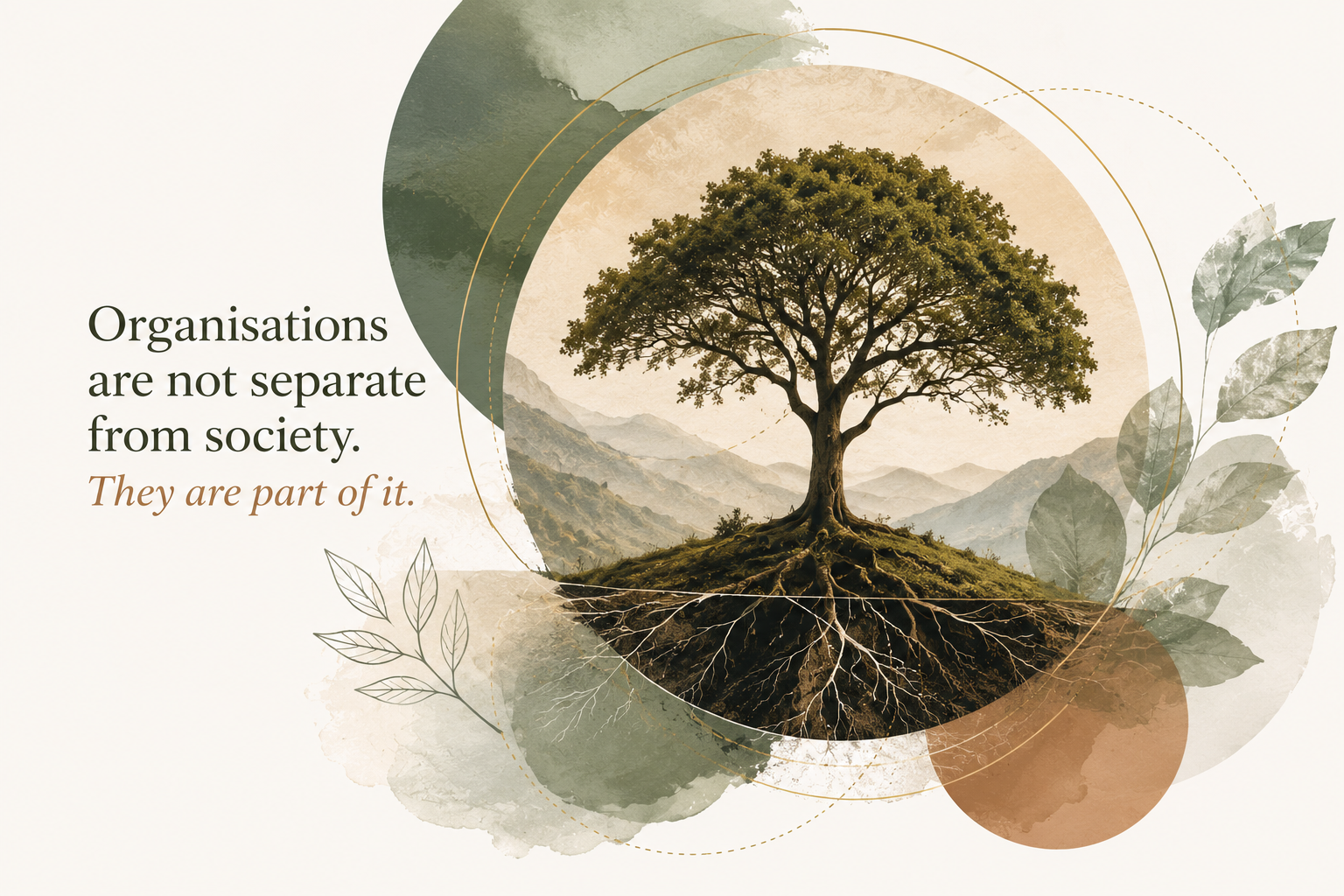
Much of organisational thinking assumes that businesses exist as separate entities that act upon society from the outside. This separation permits social needs to be treated as externalities, risks, obligations or 'outside of our core business' concerns.
However, in my work, this separation has proven to be one of the primary reasons why any initiatives to create shared value become incongruent in practice.
Why This Matters in Our Context
In South Africa, where inequality, race, colonial history and economic exclusion remain deeply present, business and society no longer have the preference of considering themselves as separate.
The role of business must be reimagined through socially responsive commitments to transformative approaches to the creation of value that is both economically viable and deeply humanitarian.
Conclusion
The unbound organisation invites a shift in perspective. It demands that we move beyond a distinctive business and society to delivering value that is mutually social and economic.
This shift requires that social needs are no longer peripheral to organisational objectives or external to strategy. Community is no longer an outskirted burden. Dialogue is no longer a tickbox exercise of community engagement. Instead, all are essential to how value is understood, created and sustained.